




Know Your LPA
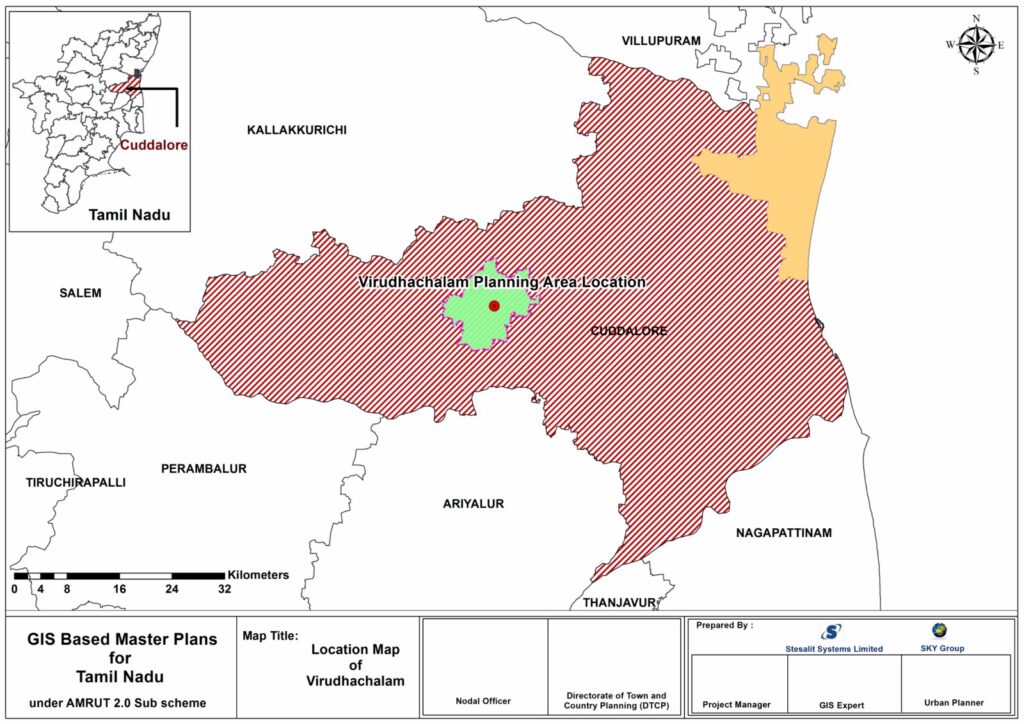
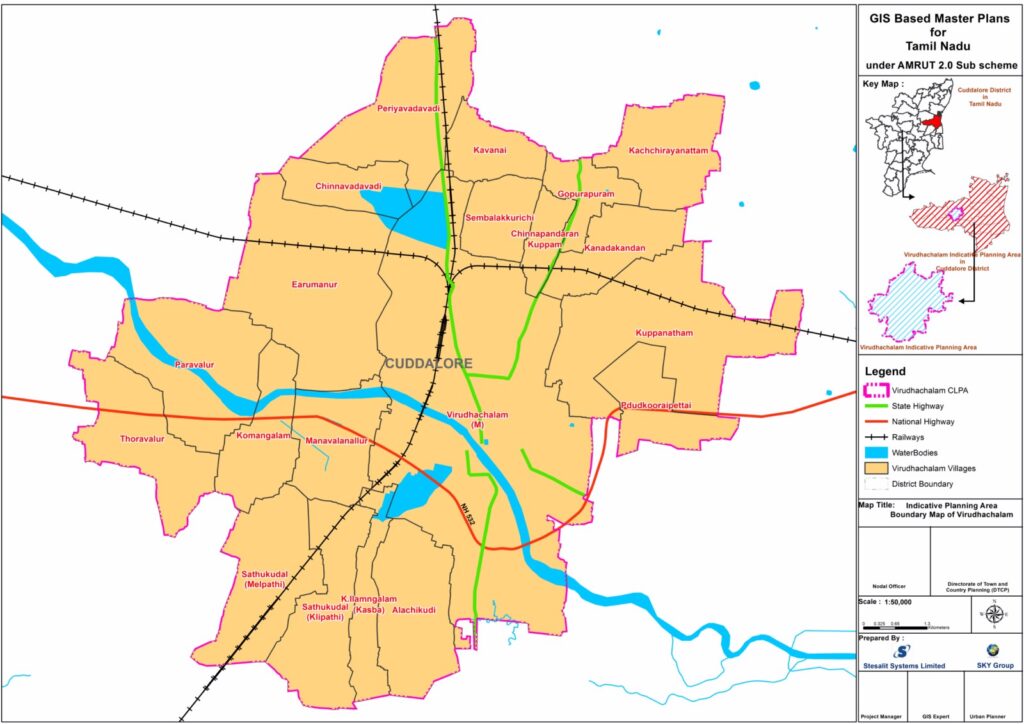
Virudhachalam Local Planning Area is a Composite LPA comprising of Virudhachalam Municipality and surrounding 19 revenue villages with an extent of about 105.42 sqkm.
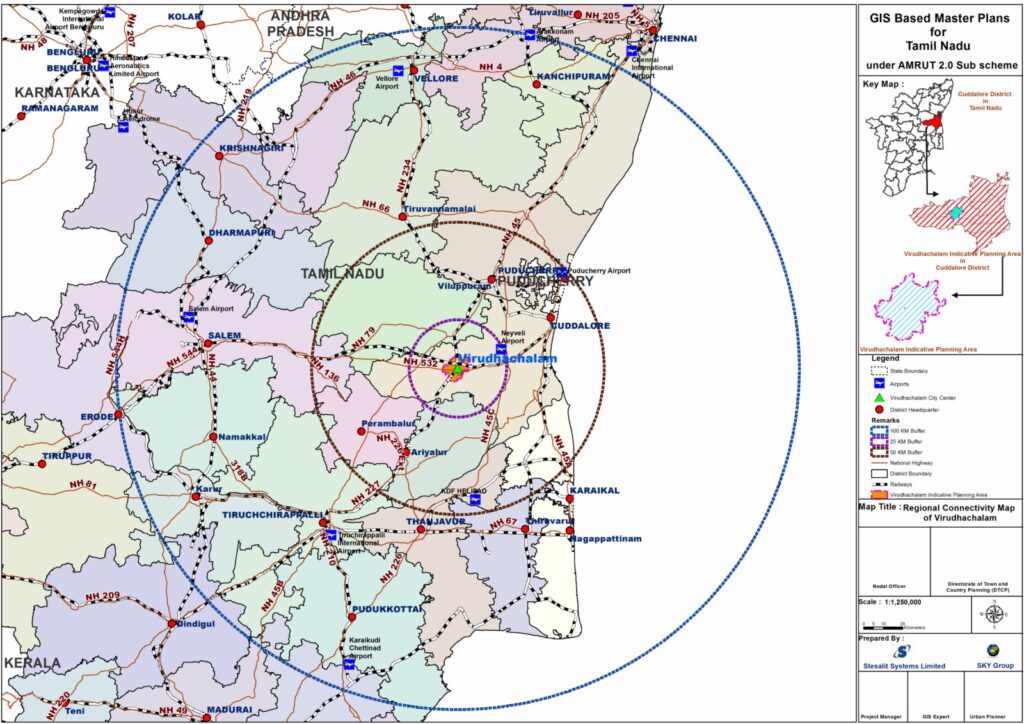
Virudhachalam is a town located in the Cuddalore district. Positioned approximately 200 kilometers southwest of Chennai and 60 kilometers west of Cuddalore, the town occupies a strategic location in the central-eastern part of the state. Virudhachalam is situated near the Vellar River, which supports local agriculture and provides water resources for the area. Virudhachalam is an important transportation hub, with the Virudhachalam Junction railway station serving as a major rail link for the region.
Virudhachalam holds a significant place in the state’s history, with its roots tracing back to ancient times. Known historically as Thirumudhukundram and later Vriddhachalam, meaning “hill of old age,” the town is particularly renowned for its association with Shaivism and the presence of the revered Vriddhagiriswarar Temple, a major Hindu temple dedicated to Lord Shiva. The town was historically part of the Chola kingdom, after the decline of the Cholas, the Pandya dynasty briefly took control over Virudhachalam and its surrounding areas.
Master Plan
A Master Plan under the Tamil Nadu Town and Country Planning Act is the principal statutory instrument that lays down the vision, land use structure, development control regulations, and infrastructure framework for planned growth of a notified planning area, ensuring orderly urban development.
- To regulate land use, control building activity, and reserve land for public purposes.
- To provide a long-term spatial strategy (typically 20 years or more) for housing, transport, industry, commerce, recreation, and environmental protection.
- To ensure orderly development of towns and cities in Tamil Nadu.
According to the Act, a Master Plan generally includes:
- Land use zoning – classification of land for residential, commercial, industrial, public/semi-public, recreational, and agricultural uses.
- Zoning regulations (ZR) – rules for building activity, such as Floor Space Index (FSI), setbacks, building heights, plot sizes, etc.
- Reservation of land for roads, parks, open spaces, public buildings, schools, markets, and other community facilities.
- Proposals for infrastructure – transportation networks, water supply, sewerage, drainage, power, and solid waste management.
- Environmental considerations – conservation of water bodies, hill areas, forests, and heritage structures.
- Phasing and implementation measures – stages of development, enforcement mechanisms, and coordination with other government agencies.
- Declaration of Local Planning Area (LPA) by Government under the Act.
- Preparation of the Master Plan by the Local Planning Authority (LPA) with technical inputs.
- Public consultation – draft plan is published for objections and suggestions.
- Approval by the State Government after modifications, if necessary.
- Implementation and enforcement through development control regulations, layout approvals, and building permits.
- Once sanctioned, all land development and building activity must conform to the Master Plan provisions.
- Any deviation requires Government approval or amendment of the plan.
- It provides the legal basis for granting/rejecting building permissions and land use change requests.
View Maps
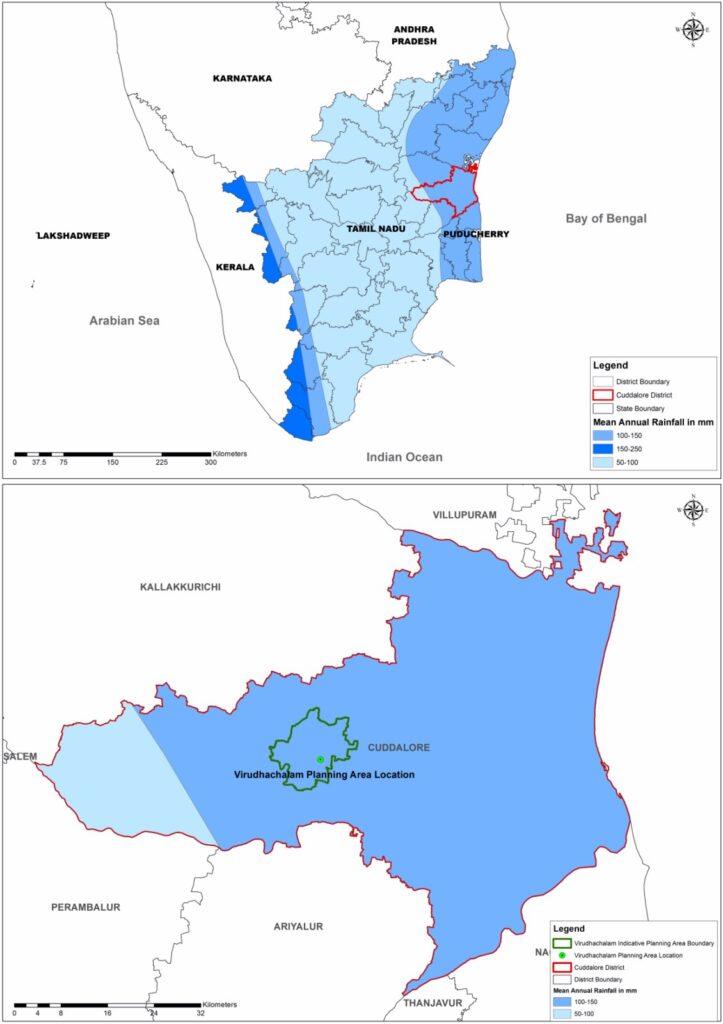
Annual Rainfall Map
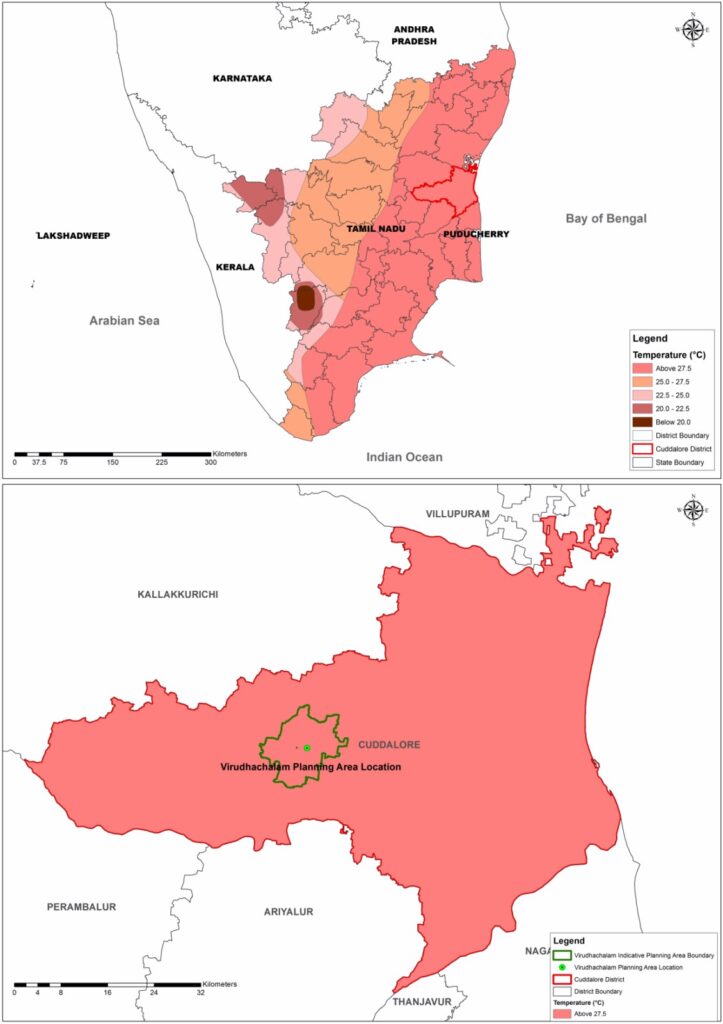
Average Annual Temperature Map
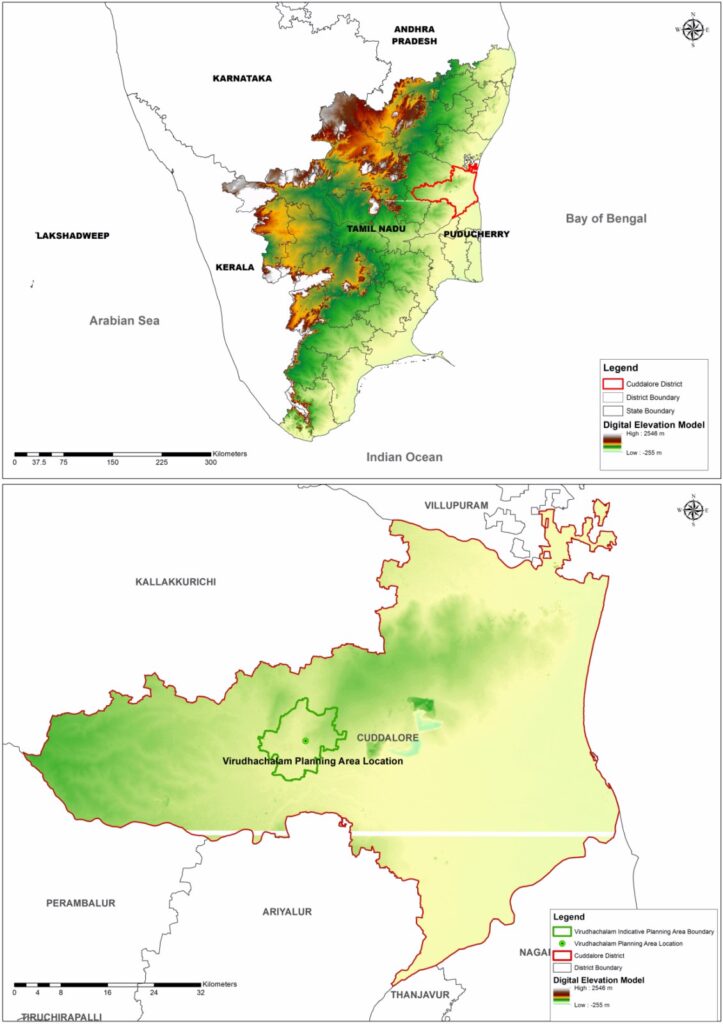
DEM Map
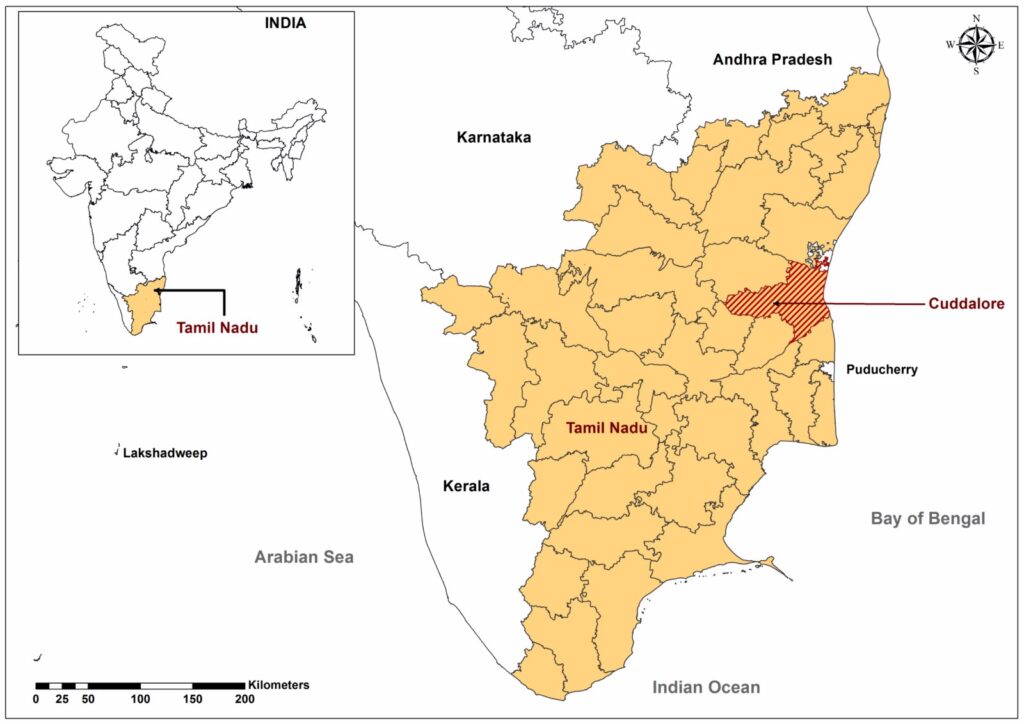
Location Map1
Location Map2
Regional Connectivity Map
Virudhachalam CLPA Planning Area Map
DOWNLOADS


Amrut 2.0
Objective Alignment
- AMRUT 2.0 emphasizes water security, universal service coverage, and sustainable urban infrastructure.
- For preparing GIS-based master plans, this mission provides a national mandate to integrate water supply, sewerage, drainage, green spaces, and environmental management into spatial planning.
GIS as a Core Tool
- The operational guidelines of AMRUT 2.0 make GIS technology central to the planning process.
- Key applications in master plans:
- Creation of GIS basemaps for all statutory towns and urban areas.
- Digitization of cadastral maps, utility networks, and service delivery infrastructure.
- Integration of remote sensing and drone data for land use, land cover, and natural features.
- Development of thematic layers for water supply pipelines, sewer networks, stormwater drains, parks, and water bodies.
- GIS-enabled monitoring dashboards for real-time project tracking.
Outputs for Master Plans
- Existing Land Use (ELU) Maps prepared on GIS basemaps, compliant with URDPFI/AMRUT standards.
- Infrastructure gap analysis using GIS overlays (e.g., households without piped water vs. water supply networks).
- Suitability analysis and growth corridors identified through weighted overlay of physiography, environment, transport, and utilities.
- Zoning and development control regulations (DCRs) mapped spatially, ensuring enforcement through GIS portals.
- Scenario building (population, economy, housing demand) visualized spatially for long-term growth under AMRUT 2.0.
Capacity Building & Integration
- AMRUT 2.0 funds capacity building in urban local bodies (ULBs) for using GIS tools.
- Encourages integration with state GIS portals (e.g., KGIS in Karnataka, TN-eGIS in Tamil Nadu).
- Promotes digital governance by linking master plan layers with building permission and approval systems.
Approach to Master Plan Preparation

Sustainability and Resilience
The approach to preparing a master plan must be grounded in the principles of sustainability and resilience. A sustainable city balances economic growth with ecological preservation by safeguarding water bodies, wetlands, green cover, and biodiversity zones. Climate resilience becomes a critical priority, and therefore, the master plan must incorporate strategies for flood management, drought preparedness, and mitigation of urban heat islands through blue–green infrastructure. Resource efficiency is also central, with emphasis on renewable energy adoption, sustainable mobility options such as public transport and non-motorized transport, and compact, mixed-use development patterns that minimize the carbon footprint. At the same time, resilient infrastructure design is essential, ensuring that water supply, sewerage, transport, and power networks are capable of withstanding climate shocks, disasters, or sudden demographic shifts.

Data Driven
Data-driven planning forms the backbone of a modern master plan. Evidence-based analysis ensures objectivity, transparency, and accountability. The use of GIS basemaps and remote sensing allows precise land use mapping, environmental assessment, and identification of service gaps. Emerging tools such as big data and IoT inputs, including traffic counts, utility consumption data, and citizen service requests, can highlight patterns and urban challenges more effectively. Predictive modelling techniques further strengthen the planning process by projecting population, employment, and housing demand, while GIS-based decision support systems allow spatial evaluation of different growth scenarios. This scientific approach ensures that decisions are not ad-hoc but anchored in real-time data and future forecasts.

Citizen Centric
Equally important is a citizen-centric orientation. A master plan should be prepared with people and for people, embedding participation and inclusivity at every stage. Multi-stakeholder consultations, including residents, industry, and civil society, provide diverse perspectives and enhance acceptance of the plan. Making plan data and proposals accessible through online portals and interactive GIS-based tools encourages transparency and empowers citizens. The plan should address inclusivity by ensuring equitable access to housing, infrastructure, and livelihoods for vulnerable sections such as the urban poor, women, the elderly, and differently abled populations. Feedback mechanisms must be established so that citizen voices are incorporated during both draft and final stages, making the plan a living document rather than a static one.
Finally, the master plan must be conceived as an instrument of integrated development. It is not limited to land use zoning but must harmonize physical, economic, social, and environmental aspects of city growth. Sectoral integration is essential to ensure that land use decisions align with transport planning, housing strategies, water supply, sanitation, solid waste management, energy distribution, and disaster risk management. The plan should also adopt a regional perspective, ensuring consistency with metropolitan and regional strategies to avoid fragmented development. Inter-agency coordination plays a vital role, with efforts by urban local bodies, development authorities, state agencies, and parastatals aligned under a common vision. Moreover, implementation strategies must be realistic, with proposals phased according to financial resources and institutional capacities.
In conclusion, a modern master plan is far more than a conventional land use document. It is a strategic, dynamic, and digital framework that integrates sustainability, resilience, data analytics, citizen participation, and multi-sectoral coordination. By following this holistic approach, cities can evolve as inclusive, adaptive, and future-ready systems. Such an approach also aligns local planning efforts with national programmes like AMRUT 2.0, the Smart Cities Mission, and the Gati Shakti initiative, ensuring that urban growth is not only planned but also transformative.
Updates

Updates on Virudhachalam Local Planning Area
This section will be used to keep you updated on the development of the Virudhachalam Local Planning Area (LPA). The LPA is a Composite Planning Area that includes Virudhachalam Municipality along with 19 surrounding revenue villages, covering an extent of 105.42 sq. km. District: Cuddalore Local Planning Area: Virudhachalam Proposed Master Plan Area: 105.42 sq. km Coordinates: 11.51° N, 79.32° E Virudhachalam is located about...